
Caramel curiosities
10 Interesting Facts About Caramel You May Not Know
At first glance, there isn’t much to say about caramel.
It’s sweet, it’s brown and it’s simply divine!
End of article.
Except when we started digging a little deeper, we discovered that caramel has a surprisingly colourful history. There’s possibly a thousand years of history, a little chemistry and neuroscience, sports nutrition, marketing tricks and even one rather comical court case.
So grab a spoon, a jar of caramel and let’s get started.
1. Who Invented Caramel? We Don’t Know
And we’re not going to make up a marketing fairy tale or some dramatic story.
With some foods, we have a lovely story about how they were invented. With caramel, we have more of a historical fog.
It’s often claimed that something resembling caramel was being made by Arab confectioners as early as around the year 1000.
But we don’t know who was first. And it’s quite possible that caramel was invented independently more than once. And if everyone was as skilful as I am, we can probably assume that caramel appeared at roughly the same time humans first tried heating anything sweet.
Humanity may therefore have repeatedly arrived at the same groundbreaking discovery:
If we burn sugar just a little, it gets even better.
2. Caramelised Milk Isn’t Caramel with Cream
Here comes a little culinary injustice.
Dulce de leche, also known in various forms as caramelised or cooked condensed milk, looks like caramel. It tastes a little like caramel. It’s sold alongside caramel.
But it’s made differently.
With classic cream caramel, the sugar is heated first until it begins to caramelise. Only then are cream, butter and any other ingredients added.
With dulce de leche, milk and sugar are heated together for a long time. This brings milk proteins into play and different reactions take place, particularly the famous Maillard reaction, which you can also see in baked goods or the browned surface of roasted meat.
Dulce de leche is related to caramel, but it isn’t caramel.
It’s a bit like custard and ice cream. The colour and flavour can be quite similar and some of the ingredients overlap, but nobody would claim that ice cream is just cold custard.
3. Caramel Isn’t a Single Chemical Compound
If you were expecting there to be one specific chemical compound somewhere called “caramel”, we have a little surprise for you.
Heating sugar creates an entire mixture of different substances. Some contribute to the colour, others to the aroma and others to caramel’s characteristic flavour.
So what we call “caramel flavour” is actually an entire chemical orchestra.
You may not recognise the individual instruments.
But together, they play damn well.
4. Why Is Watching Caramel Flow So Satisfying?
Imagine an advert for caramel.
What do you see?
A jar sitting quietly on a table?
No.
Caramel flows.
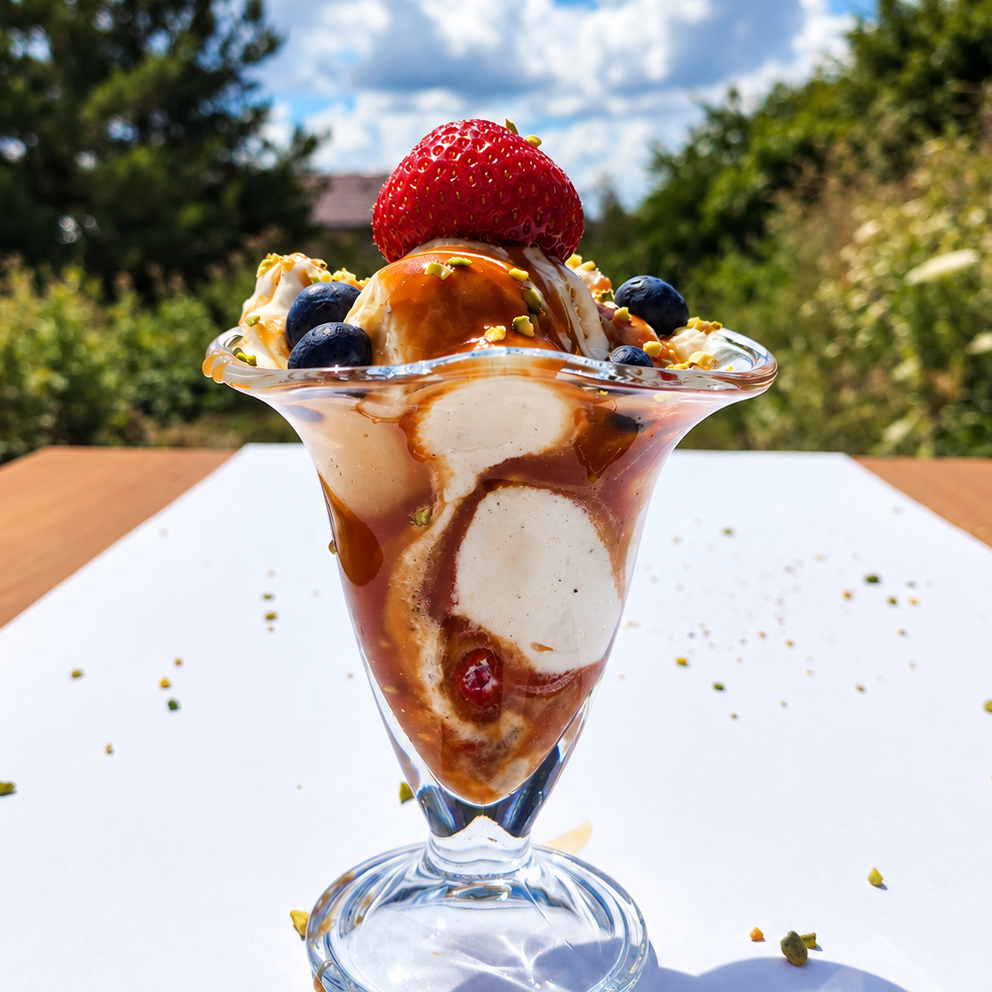
It slowly pours over ice cream, stretches from a spoon, runs down a cake or lazily folds over itself.
And that isn’t an accident.
The human brain can estimate the properties of a liquid simply by watching how it moves. It observes the speed of the flow, its shape, shine and the way the liquid stretches and lands. Before we’ve even tasted something, we already have an idea whether it will be watery, thick, creamy or sticky.
Caramel is almost perfect for this kind of visual experience.
It flows slowly enough for us to see its movement clearly. It shines. It forms folds and long, stretching strands.
So the brain gets a taste before the tongue does.
Perhaps that’s why almost nobody films a caramel advert in which the caramel sits politely in a jar doing absolutely nothing.
Caramel in motion is caramel alive.
5. We Don’t Experience Caramel with Our Tongue Alone
When you put caramel in your mouth, your brain doesn’t simply process the information:
SWEET.
At the same time, it receives information about aroma, temperature, thickness, fat and texture. There are even neurons in the brain that respond to properties of food such as viscosity and texture.
And all of this information gradually comes together.
To the brain, the difference between a spoonful of sugar and a spoonful of cream caramel is much greater than it might initially seem.
Caramel engages your nose, tongue and receptors in your mouth all at once.
The brain puts all that information together and says something along the lines of:
Yes. We could do that again.
Possibly repeatedly, until the jar is completely empty.
By the way, did you know that for most people, eating the first 95% of a jar takes almost exactly as long as eating the final 5%, when it stops being a matter of scooping with a spoon and starts resembling gold mining? 😊
6. Caramel and Sport? Actually, They Make Quite a Logical Pair
When someone says sports nutrition, you probably imagine protein or an energy gel in a neon-coloured sachet with a name like ULTRA POWER MAX 9000.
Less often, a jar of caramel.
But the principle is fairly simple.
During prolonged physical activity, the body needs energy, and carbohydrates are among its rapidly available energy sources. Caramel is an energy-dense food, and the cream version also provides fat and a little protein.
That obviously doesn’t mean we recommend running a marathon with a jar of Karamílek in your hand.
But on a long walk, hike or after sport, a few spoonfuls of energy-rich food aren’t nearly as absurd an idea as they might sound.
And unlike some sports gels, at least you get the feeling that you’ve just eaten something that was originally intended to be food.
Food that feels like a reward, not a punishment. 😊
7. Caramel and Dieting: How Many Calories Does It Really Contain?
Caramel is not a diet vegetable.
We could end this section with that groundbreaking nutritional discovery.
Except we have a peculiar tendency to divide food into “sins” and things we can consume almost without noticing. And sometimes the energy content paints quite a different picture.
For example, a 500 ml bottle of Coca-Cola contains approximately 225 kcal. You’ll find roughly the same amount of energy in 57 grams of our caramel. That’s more than a quarter of a jar of our salted Karamílek.
A McDonald’s cheeseburger? Roughly the same amount of energy as 78 grams of caramel. That’s already more than a third of a jar of our caramel goodness.
An ordinary 130 g bag of salted crisps? To match that, you’d need to eat around 176 grams of caramel. A bag of crisps in front of the TV is hardly unusual, so even eating seven eighths of a jar of Karamílek in an evening isn’t complete nutritional suicide. The much greater sin is how little you’ve left for everyone else – or for yourself later. 😊
And now for our favourite comparison:
One litre of Relax 100% orange juice contains 440 kcal. In terms of energy, that’s roughly equivalent to 112 grams of our caramel.
That’s more than half a jar of caramel temptation.
Of course, we’re not claiming that caramel and orange juice are nutritionally the same thing. They aren’t. Just as caramel isn’t the same thing as a cheeseburger or crisps.
But in terms of energy alone, it’s interesting how differently we perceive them.
Drinking a litre of juice over the course of a day might not feel like a major gastronomic offence. Eating 112 grams of caramel sounds more like an event you ought to conceal from your family.
In terms of energy, though, the number is the same.
So no, we’re not going to tell you that Karamílek will make you lose weight. We’d need a considerably more creative marketing department for that.
But a few spoonfuls of something you genuinely love don’t have to be a caloric apocalypse either.
Quantity matters. Two spoonfuls of something you really enjoy can simply be two spoonfuls.
There’s no need to convene a nutritional tribunal over them.
8. Why Does Caramel Sell So Well?
Next time you walk past the confectionery aisle, play a little game.
Look for caramel.
Not actual caramel.
Pictures of caramel.
On chocolate and confectionery packaging, it’s usually beautifully golden, glossy and, above all, dramatically flowing. Sometimes it pours out of a cut-open product in quantities that make you expect you’ll need a mop after opening the wrapper.
Then you cut the actual product open.
And the archaeological excavation begins.
“Hang on… the caramel must be in here somewhere.”
Manufacturers know perfectly well that caramel isn’t just an ingredient. It’s also a visual promise.
Its golden-brown colour, shine and flowing texture can communicate “sweet, rich, creamy and delicious” on a package far faster than a paragraph of text.
That’s why caramel is often one of the stars of the packaging even when, according to the actual ingredients list, it’s playing more of a supporting role.
9. Someone Really Went to Court over the Word “Caramel”
And now for one of our favourite curiosities.
In the United States, a customer sued the manufacturer of Nips hard caramel sweets.
She objected to the words “Caramel” and “Rich & Creamy” on the packaging because, in her view, the product did not contain as much milk fat as she expected from such labelling.
The case made it all the way to federal court.
The court rejected her argument.
With our Karamílek, there’d be no need to go to court at all.
To make 100 grams of our caramel, we use approximately 46 grams of cream.
We don’t call it cream caramel just because it sounds nice.
10. The Miser Who Nearly Drowned in Caramel
At the end of the 19th century, there was a small butter-caramel factory in northern France whose owner was known locally for two things.
Excellent caramels and absolutely phenomenal stinginess.
According to the surviving story, he kept track not only of the amount of sugar and butter used, but even of the caramel left clinging to the sides of the large copper vats after production. His employees weren’t allowed to throw it away. They had to scrape it off carefully, weigh it and melt it back into the next batch.
One evening in 1897, the owner discovered that one of the vats hadn’t been cleaned to his satisfaction.
Several kilograms of caramel remained on its sides.
And several kilograms of caramel meant money.
Since the workers had already gone home, he decided to scrape off the leftovers himself.
The vat was large, the caramel at the bottom was still warm and the floor around the production area was slippery. The owner leaned inside, stretched towards the last remnants at the bottom – and fell in.
And at that moment he discovered something you don’t usually read in confectionery manuals:
Swimming in caramel is surprisingly difficult.
The caramel coated his hands and clothes, and every time he tried to stand up, he slipped again. On top of that, the vat was so deep that he couldn’t climb over the rim.
He was saved only by chance.
One of the workers returned to the factory for a forgotten hat, heard swearing coming from inside the vat and called two other men. Together, they pulled the owner out.
He survived without serious injury.
And according to local legend, the following morning he introduced two new company rules.
From then on, nobody was allowed to climb into the production vats.
And leftover caramel could be thrown away.
Lovely story.
The miser is punished for his greed, caramel nearly wins, and everything turns out well in the end.
There’s just one tiny problem.
None of it ever happened.
We know of no French caramel manufacturer who got stuck in his own vat in 1897. We made up the factory, the owner, the forgotten hat and the three men who pulled him out of the caramel.
Why?
Because the previous nine facts are absolutely true, and we wanted to see whether we could finally get you to fall for one – or, in this case, get you stuck in the caramel.
So if you believed the story, don’t worry. It’s the first and last time we’ve cheated a little and played a game of fact or fiction with you.
And if you knew all along that it was nonsense, you have every right to feel rather pleased with yourself.
And While We’re on the Subject of Fact or Fiction…
On our jars, you’ll find a recommendation to keep Karamílek refrigerated after opening and consume it within 14 days.
And now for the question:
Can an opened jar of caramel last much longer in the fridge?
From our own experience, we know that it can.
The trouble is that proving it is surprisingly difficult.
Not microbiologically.
Logistically.
Because how exactly do you keep an opened jar of Karamílek in the fridge for six months?
Our experiments so far suggest that you’d need a fridge wrapped in chains, a good padlock and the key thrown, as a precaution, to the bottom of the Mariana Trench.
And even then, it isn’t entirely foolproof. People can be remarkably inventive when they’re planning the “Great Caramel Robbery”.
So officially, we say 14 days.
And if you want to find out whether it lasts longer, you’re of course welcome to repeat the experiment at home.
Small spoiler: the control group must not be given a spoon.